Basel
BASEL (City) and Canton BASEL-STADT
Addition: 1908 Kleinhüningen

Official blazon
Origin/meaning
The arms of the city of Basel, and the canton of the same name, show the canting Baselstab (staff of Basel), originally the staff used by the Bishops of Basel. The oldest use of the staff (not a proper crosier, which would have a long wooden pole with a golden curved upper part), is known from coins dating from 1072 and 1133. A later coin, dating from the mid 13th century, shows a much clearer image of the staff, with the typical base. The staff was clearly used as the symbol of the diocese and the city, as the coins showed often the arms of the bishops beside the staff (see below).
The seals of the city initially showed a house or gate, only later the staff was also used on the city seals.
The original arms showed a red staff for both the diocese and the city. The black staff for the city dates from after 1385, when the city and diocese became more separate, each having its own jurisdiction and council. The first known use of the black staff dates from the early 15th century.
The origin of the typical base of the staff is not clear. Many different theories have been proposed during the centuries, but no single explanation has been proven.
Since the end of the 14th century supporters have often been used with the arms. The oldest supporter was an angel, standing behind the shield. At the end of the 15th century a basilisk appears as supporter. This beast was probably chosen as a canting symbol. A basilisk is a combination of a lizard with dragon wings, a rooster's head and an eagle's bill.
The basilisk has been used for several centuries, but is no longer used since the early 19th century. In the meanwhile also savages were sometimes used as supporters.
Image gallery
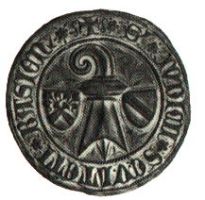
The arms on a coin from 1384 (eBay)
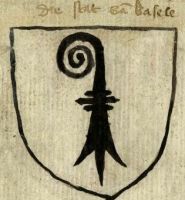
The arms in the Armorial Gorrevod (1460)
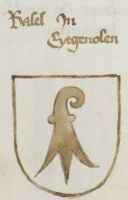
The arms in a 15th century manuscript
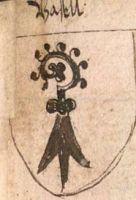
The arms in the late 15th century
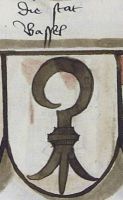
The arms in the Armorial Jörg Rügen (1495)
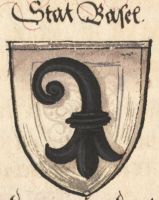
The arms around 1500
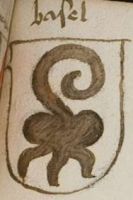
The arms in a manuscript from 1514
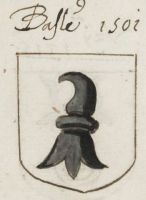
The arms in a 16th century manuscript
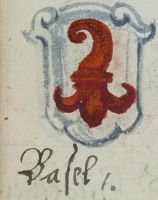
The arms in a 16th century manuscript
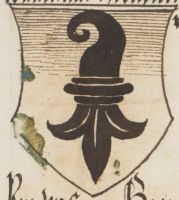
The arms in a manuscript from 1576
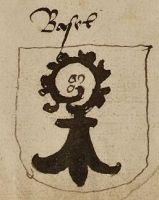
The arms in the Armorial Ribeaupierre (16th century)

The seal from the 13th century
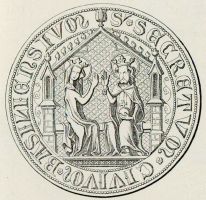
The seal from 1405
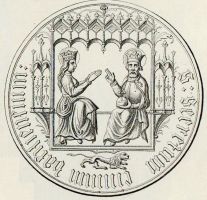
The seal from 1420
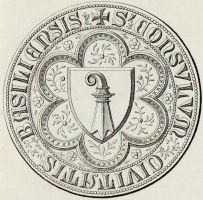
The seal from the 15/16th century
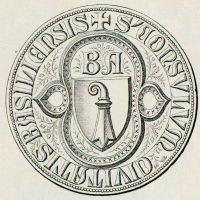
The seal from the 15/16th century
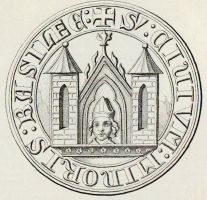
The seal from Kleinbasel from the 13th century

The arms on a glass panel in the Historisches Museum, Luzern
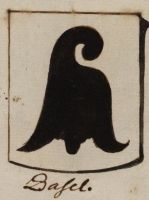
The arms in the Wapen- en Vlaggenboek van Gerrit Hesman (1708)
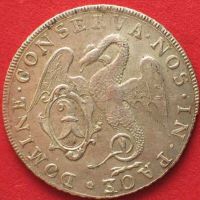
The arms on a coin from 1740 (eBay)
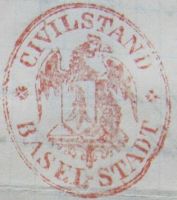
Seal from the 1920s (?)

Municipal stationery, 1960s
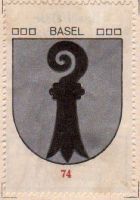
Variations of the arms in the Kaffee Hag albums 1914-1960
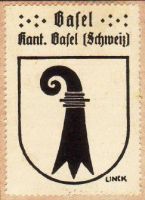
Variations of the arms in the Kaffee Hag albums 1914-1960
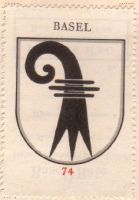
Variations of the arms in the Kaffee Hag albums 1914-1960
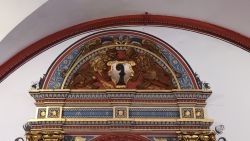
The arms in the city (image R. Fischer, 2022)
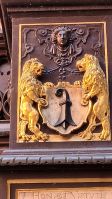
The arms in the city (image R. Fischer, 2022)
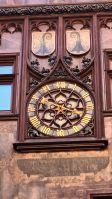
The arms in the city (image R. Fischer, 2022)

The arms in the city (image R. Fischer, 2022)

The arms in the city (image R. Fischer, 2022)


Literature: Mühlmann, L.: Wappen und Fahnen der Schweiz, Bühler Verlag, Lengnau, 1977 and 1997.
Swiss heraldry portal
This page is part of the  |
 |
|
Swiss civic heraldry:
|
Other heraldry: |
Contact and Support


Partners:


Your logo here ?
Contact us
© since 1995, Heraldry of the World, Ralf Hartemink 
Index of the site